

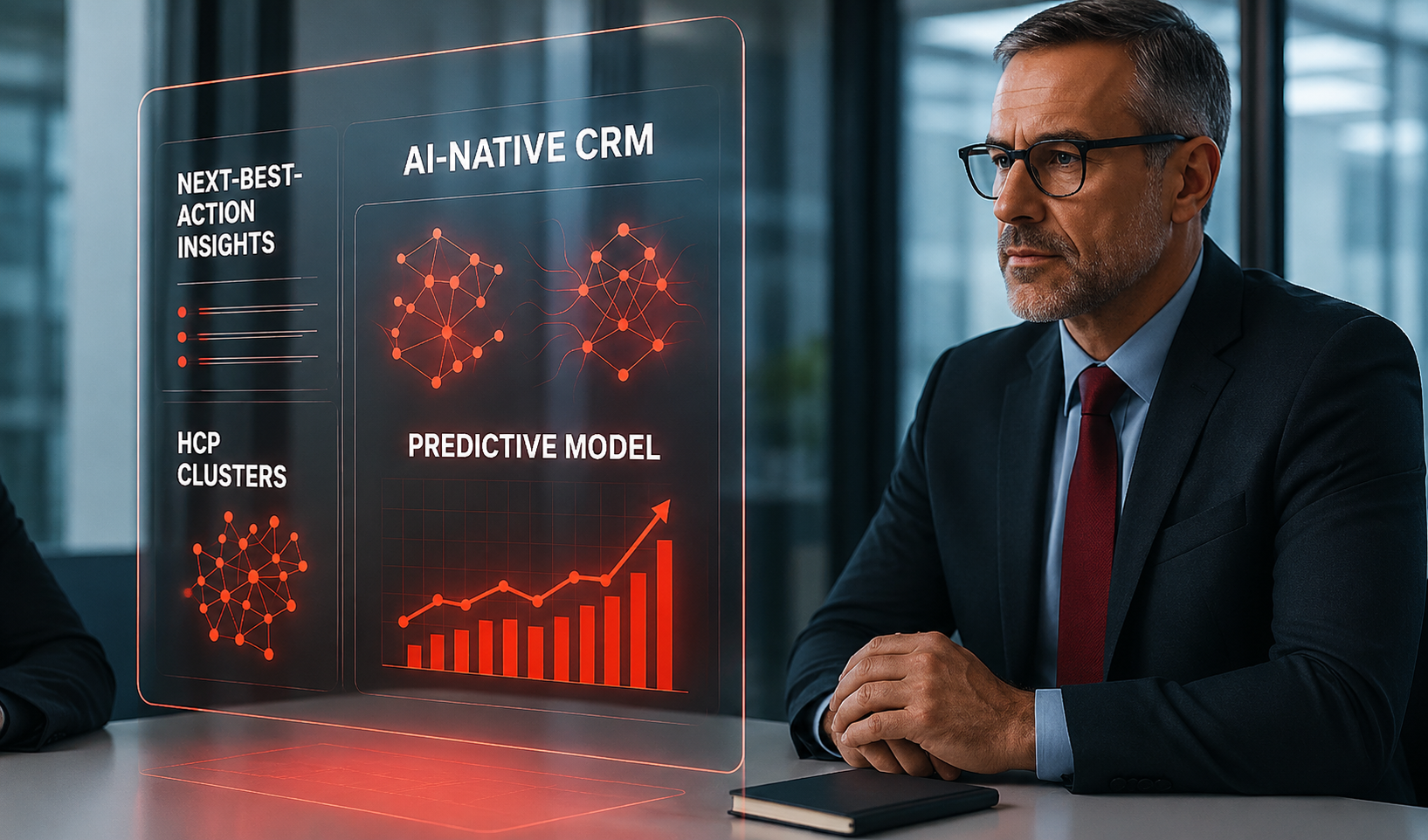
AI-native CRM is reshaping commercial execution in life sciences. Winning in the field now depends on delivering the right message to the right person at the right time. AI-native CRM makes this level of precision possible. In a market defined by rapidly multiplying channels and increasing regulatory pressure, traditional CRMs cannot keep pace with the decisions modern field teams must make.
As a result, the next CRM revolution is not incremental. It is predictive.
AI-native CRMs embed intelligence into the core architecture, turning data into prescriptive, action-ready guidance for field teams, Medical Affairs, and commercial leaders.
1. Why Traditional CRMs Now Underdeliver
For nearly twenty years, CRMs have solved one problem: storing activity. They log visits, capture notes and generate dashboards. However, in specialty pharma — where sales cycles are long, prescribers are niche, and scrutiny is intense — activity reporting is no longer enough.
Field decisions are time-sensitive and context-driven. Dashboards describing the past do not help reps decide who to engage in the next 48 hours.
This gap is well-documented in industry research.
Gartner’s Life Sciences CRM market insights, for example, consistently show that legacy CRMs fail to produce actionable intelligence without manual effort: https://www.gartner.com/reviews/market/crm-in-life-sciences
The implication is clear: storing data without real-time orchestration creates delays, wasted field activity and lost opportunity.

2. AI-Enabled vs. AI-Native — The Critical Difference
Many vendors promote “AI features” layered onto legacy systems — analytics dashboards, widgets, recommendation plugins. However, these are AI-enabled systems. They provide value, but they are retrofitted, not built for intelligence.
An AI-native CRM is architected from the ground up around:
- continuous learning
- predictive modeling
- closed-loop feedback
- real-time orchestration
It constantly ingests field behavior, prescribing signals, engagement outcomes and market changes, refining Suggested Activities, re-segmenting HCPs in real time and optimizing territory execution.
This approach aligns with McKinsey’s findings in The State of AI: How Organizations Are Rewiring to Capture Value (2025) — organizations that embed AI into operating models scale value dramatically faster: https://www.mckinsey.com/capabilities/quantumblack/our-insights/the-state-of-ai
AI-native architecture transforms intelligence into operational advantage, not just reporting.
3. How Predictive Intelligence Changes Field Execution
Predictive CRMs shift organizations from activity measurement to outcome optimization.
Key AI-native capabilities include:
• Suggested Activities
Prescriptive recommendations indicating WHO to contact, WHEN, and VIA WHICH channel — aligned to scientific context and engagement preference.
• Predictive HCP segmentation
Dynamic scoring based on prescribing behavior, responsiveness and local access constraints.
• Real-time territory optimization
Routes, frequency and outreach plans adapt automatically to new data — formulary shifts, events, competitive moves or access barriers.
• Closed-loop learning
Each rep/MSL action and its outcome retrains the model, increasing precision over time.
Operational outcome:
Higher call relevance, better allocation of scarce field time and faster conversion from scientific exchange to measurable clinical or commercial impact.
This pattern reflects sector-wide results highlighted by Deloitte and PM360: predictive orchestration consistently drives productivity gains and speed-to-impact.
4. Operational ROI: Why AI-Native CRM Multiplies Value
The financial argument extends beyond improved targeting. AI-native CRM unlocks ROI across four dimensions:
• Faster time-to-value
Intelligent architectures reduce integration complexity and consulting overhead. Deloitte’s 2025 Life Sciences Executive Outlook identifies AI-native deployments as materially faster and more effective than module-based legacy rollouts: https://www.deloitte.com/us/en/insights/industry/health-care/life-sciences-and-health-care-industry-outlooks/2025-life-sciences-executive-outlook.html
• Lower total cost of ownership (TCO)
Predictive engines, BI and compliance automation live inside one unified stack — eliminating the need for external tools, connectors or duplicate analytics.
• Fewer manual tasks
Automated reporting, validation and compliance workflows slash administrative burden, freeing reps/MSLs for high-value scientific engagement.
• Higher compliance efficiency
Native audit trails and integrated governance reduce compliance risk and shrink audit preparation cycles. Real-time logging offers superior oversight with less effort.
Put simply: AI-native CRM compounds benefits across productivity, cost, compliance and deployment speed.
For a deeper look into how predictive orchestration works inside Close-Up CRM, explore our CRM Suite overview: https://closeupcrm.com/crm-suite/
5. Compliance by Design: Automation Strengthens Governance
A persistent misconception is that automation increases compliance risk. In reality, manual logging creates exposure.
Automation enhances control.
AI-native CRMs operationalize compliance inside the workflow:
- role-based permissions
- automated audit trails
- required approvals for materials
- real-time validation
- sensitive-field redaction
When governance is embedded into execution, audit readiness becomes a by-product of normal field activity — not a separate project.
6. Why Close-Up CRM Fits the Predictive Mandate
Close-Up CRM is engineered around a pharma-first, AI-native architecture, delivering:
- Predictive Suggested Activities enriched with behavioral and scientific context
- Unified analytics without extra BI licensing
- Compliance workflows aligned to HIPAA, GDPR and regional requirements
- Mobile-first UX with role-centric dashboards
This approach aligns with leading guidance from McKinsey, Gartner and Deloitte:
operationalize AI, embed governance, and tie intelligence directly to business KPIs.
Close-Up CRM was built for this paradigm — not adapted to it.
7. Measuring Success: KPIs That Prove Predictive Impact
Organizations should track KPIs across both execution and outcomes:
- Suggested Activities adoption rate
- Call relevance uplift (scientific value per contact)
- Coverage efficiency (% of high-potential HCPs reached in target windows)
- Reduction in non-selling time
- Promotional ROI and conversion
- Compliance performance (audit findings, approval throughput, prep time)
Combine these KPIs with controlled pilots (A/B regions or matched territories) to produce defensible evidence before scaling.
Conclusion — Act Now or Fall Behind
Pharma’s CRM revolution is already underway — and it is predictive.
The question is not whether AI will transform CRM, but who will adopt AI-native architectures fast enough to gain the advantage.
AI-native CRM delivers:
- better recommendations
- faster deployment
- lower TCO
- stronger compliance
- measurable ROI
Close-Up CRM is purpose-built for this new era: predictive, auditable and engineered to scale globally.
If your commercial or Medical Affairs teams are still operating in record-based systems, this is the moment to evolve.
Let’s connect and explore how Close-Up CRM is helping life sciences organizations move from insight to impact — faster, smarter and fully compliant.
Request a personalized demo: https://closeupcrm.com/demo